

Why Some Movies Skip Theatres
Have you ever waited for a movie to arrive in theatres, only to find that it suddenly appears on Netflix, Prime Video, JioHotstar or another streaming service? This happens more often than many viewers realize.
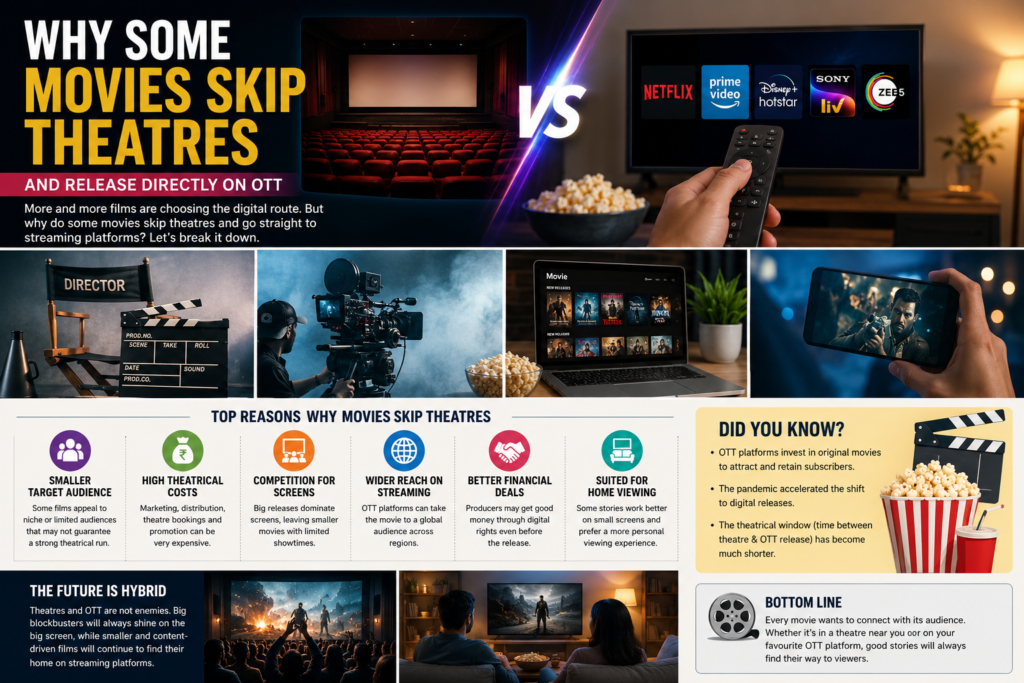
While theatrical releases are still important for big-budget films, not every movie follows the traditional theatres → OTT journey. Some films are released directly on streaming platforms, while others receive a limited theatrical run before moving online.
There isn’t one single reason behind this decision. A combination of budget, audience expectations, distribution costs, release competition, streaming deals and the filmmakers’ strategy can influence where a movie is released.
What Does a Direct-to-OTT Release Mean?
A direct-to-OTT release means a movie becomes available on a streaming platform without having a conventional theatrical release first. Instead of opening in hundreds or thousands of cinemas, the movie premieres on a digital platform and becomes available to subscribers from home.
This approach became particularly visible during the pandemic, when cinemas were closed for long periods. However, the model continued even after theatres reopened because streaming created another way for filmmakers to reach audiences.
For smaller films, a direct digital release can sometimes be a practical alternative to competing for limited cinema screens.
1. The Movie May Have a Smaller Target Audience
A film may have an interesting story and strong performances but still appeal mainly to a specific group of viewers. For example, a slow-paced mystery, an experimental drama or a niche regional film may have a smaller potential audience than a major commercial action movie.
Instead of depending on audiences in a particular city to buy tickets during the opening weekend, the movie can reach viewers across different locations through one streaming platform.
2. Theatrical Releases Can Be Expensive
Putting a movie into theatres involves much more than simply delivering it to cinemas.
There are expenses connected with:
- Advertising and promotion
- Distribution
- Theatre bookings
- Prints and digital delivery
- Marketing campaigns
- Publicity events
- Promotional partnerships
A producer has to spend money to make people aware that the movie is playing in theatres. For a smaller film, recovering these costs can be difficult if the opening response is weak. A streaming deal can provide an alternative revenue source without requiring the same level of theatrical promotion.
3. Competition for Theatre Screens
A big star movie, franchise film or major festival release can occupy a large number of screens. Smaller films may struggle to get good showtimes or enough screens to build an audience.
Even if a movie receives positive reviews, poor screen availability can affect its theatrical performance. OTT removes this particular problem. Once a film arrives on a streaming platform, viewers don’t have to search for a nearby cinema or wait for a suitable showtime.
4. Streaming Platforms Offer a Different Audience
One of the biggest advantages of OTT is the ability to reach viewers beyond major cities. A movie that has limited theatrical appeal in one region may find viewers elsewhere after appearing on a streaming service.
A Malayalam, Tamil, Telugu, Kannada or Marathi film can potentially reach viewers outside its original market when it becomes available with subtitles or dubbed audio. This gives filmmakers an opportunity to find an audience that may not have been large enough for a traditional theatrical run.

5. The Producer May Already Have an OTT Deal
Sometimes the decision is connected to the movie’s financial arrangement. Streaming platforms can acquire digital rights before or after a movie is completed. Depending on the agreement, the producer may have a clear source of revenue from the digital rights. This can reduce some of the uncertainty associated with relying entirely on theatrical box-office collections.
However, the exact terms of these deals are different from one movie to another, so there isn’t a universal formula for how much a producer receives.
6. A Movie May Perform Better as a Streaming Title
Some movies are better suited to home viewing than a theatrical event. A quiet drama may not create the same excitement as a large-scale action film on a cinema screen. But viewers may happily watch it at home when they have time.
OTT also allows people to pause, continue later and watch at their own pace. For character-driven films, documentaries and smaller dramas, this can be an advantage.
7. Release Timing Can Matter
Timing is extremely important in the movie business. A film released during a crowded weekend may struggle to attract attention even if it is good. Imagine several major movies arriving on the same Friday. Audiences have limited time and money, while theatres have limited screens. A smaller film can easily get pushed into less favorable showtimes.
Moving the movie to OTT later—or sometimes directly to OTT—can give it a different release strategy.
8. The Movie May Have Already Recovered Part of Its Cost
Revenue can come from different rights, including:
- Satellite television rights
- Digital/OTT rights
- Music rights
- Overseas distribution
- Regional distribution
- Brand partnerships
If a producer has already secured important rights deals, the pressure to generate a huge theatrical collection may be lower. This doesn’t necessarily mean the movie is unsuccessful. It simply means the business model is different.
9. Some Movies Get a Limited Theatrical Release
Not every movie that appears on OTT without a long cinema run actually skipped theatres completely. Some films receive a limited theatrical release in selected locations before becoming available online. This approach can help filmmakers give the movie a cinema presence while keeping the digital release relatively quick.
Theatrical windows have also become more flexible compared with the traditional model where audiences waited several months before a movie reached television or home video.
10. OTT Platforms Want Exclusive Content
Streaming services need new content regularly to keep subscribers interested. That creates opportunities for movies that might not have received a major theatrical campaign. A platform may see value in acquiring a film because it fills a particular genre or language category in its library.
For viewers, this means a movie that might have been difficult to find in theatres can sometimes become much easier to access online.
Does a Direct-to-OTT Release Mean the Movie Is Bad?
Not necessarily.
This is one of the biggest misconceptions surrounding digital releases. A movie’s release strategy doesn’t automatically determine its quality. Some films skip a major theatrical run because of business considerations, scheduling issues, audience size or distribution strategy. Others may genuinely struggle to find theatrical buyers.
Therefore, it is better to judge a movie based on its story, performances, reviews and overall execution, rather than assuming that an OTT release means the movie failed.
The Difference Between Theatrical and OTT Releases
| Theatrical Release | Direct-to-OTT Release |
|---|---|
| Requires cinema distribution | Distributed through a streaming platform |
| Relies heavily on ticket sales | Revenue comes mainly through digital rights/subscriptions |
| Screen availability matters | Available across supported regions |
| Opening weekend can be important | Viewers can discover it over a longer period |
| Higher promotional requirements | Platform marketing can support discovery |
| Cinema experience | Home/mobile/TV viewing |
Will More Movies Skip Theatres in the Future?
It’s difficult to say that every type of movie will move toward direct OTT releases.
Big-budget action movies, franchise films and event movies still benefit greatly from the theatrical experience. Large screens, sound systems and audience reactions remain important parts of their appeal.
At the same time, OTT is likely to remain an important route for smaller and specialized films.
The industry may therefore continue moving toward a mixed model, where different movies use different release strategies depending on their audience and business requirements.
Also read the Weekend Watch List: 10 Underrated OTT Movies & Series You Shouldn’t Miss
Also read the Top 10 Dark Mystery TV Shows You Must Watch (2026 Updated)
Also read the Which OTT Platform Is Best in India? Here’s How to Pick the Right One for You
Also read the New Ott Releases in India(August 3-8,2026)Netflix, Prime Video, Jio hotstar, Zee 5
For more Info, Please Visit the Netflix , Zee 5, Prime Video